

One of the most common questions investors ask while investing in mutual funds is:
“Should I choose the Growth option or the IDCW option?”
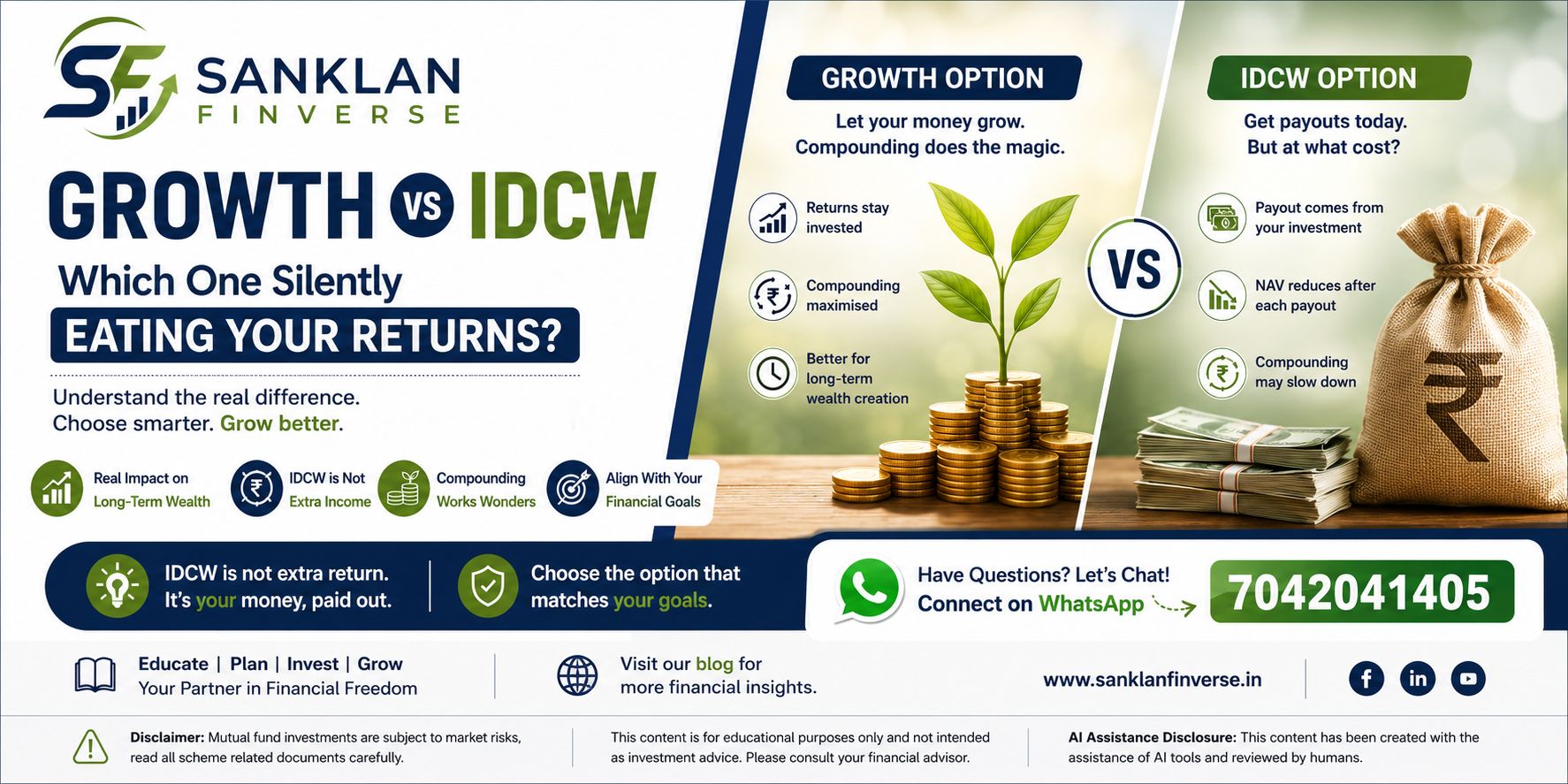
Many investors choose the IDCW (Income Distribution cum Capital Withdrawal) option believing it provides “extra income” or “bonus returns.”
However, what many don’t realize is that the money distributed under IDCW comes from your own investment or the fund’s distributable surplus—it is not an additional return generated by the mutual fund.
Understanding this difference can have a significant impact on your long-term wealth creation.
What is the Growth Option?
In the Growth Option, any gains earned by the mutual fund remain invested in the scheme.
Nothing is paid out to the investor.
Instead:
- Profits stay invested.
- Your NAV grows over time (subject to market performance).
- Future returns are earned on previous gains.
This is the power of compounding.
What is the IDCW Option?
IDCW stands for Income Distribution cum Capital Withdrawal.
Under this option, the mutual fund may distribute money to investors from its distributable surplus, subject to the availability of surplus and the fund house’s distribution policy.
Important points:
- IDCW is not guaranteed.
- The amount and frequency are not fixed.
- The fund may or may not declare an IDCW.
- When an IDCW is paid, the Net Asset Value (NAV) of the scheme falls by approximately the amount distributed (adjusted for applicable taxes and levies, if any).
The Biggest Misconception
Many investors think:
“The fund gave me ₹10 per unit as IDCW, so I earned an extra ₹10.”
This is incorrect.
Suppose:
Before IDCW:
- NAV = ₹100
- You own 100 units
- Total Value = ₹10,000
The fund declares an IDCW of ₹5 per unit.
After the payout:
- You receive ₹500.
- The NAV may reduce to around ₹95 (ignoring taxes and other adjustments for simplicity).
- Your remaining units are worth approximately ₹9,500.
Total wealth:
- ₹9,500 (investment)
- ₹500 (IDCW received)
- = ₹10,000
Your wealth has been redistributed—not increased merely because of the IDCW payment.
Comparison: Growth vs IDCW
| Feature | Growth Option | IDCW Option |
|---|---|---|
| Regular payout | No | Possible, but not guaranteed |
| Compounding | Full benefit | Reduced if payouts are not reinvested |
| NAV | Generally grows with retained gains | Reduces after IDCW distribution |
| Suitable for | Long-term wealth creation | Investors seeking periodic cash flows |
| Tax impact | Tax generally arises on redemption (subject to prevailing tax laws) | IDCW is taxable in the hands of the investor under prevailing tax laws |
| Investment value | Remains invested | Part of the investment/distributable surplus is paid out |
The Silent Effect on Long-Term Wealth
Imagine two investors each invest ₹10 lakh in the same mutual fund.
Investor A – Growth Option
- Gains remain invested.
- Returns continue compounding.
- No withdrawals.
Investor B – IDCW Option
- Receives periodic IDCW.
- Spends the payouts instead of reinvesting them.
- A smaller amount remains invested to benefit from future compounding.
Over long periods, this difference can lead to significantly different outcomes because compounding works best when gains stay invested.
The Role of Compounding
Albert Einstein is often credited with calling compounding the “eighth wonder of the world,” although there is no strong historical evidence that he actually said it.
Regardless of the quote’s origin, the principle is powerful:
- Investment earns returns.
- Those returns remain invested.
- Future returns are earned on both the original investment and earlier gains.
Repeated over many years, this can contribute meaningfully to long-term wealth creation.
Does IDCW Mean Guaranteed Income?
No.
This is another common misconception.
IDCW:
- Is declared at the discretion of the mutual fund, subject to regulations and distributable surplus.
- May stop during adverse market conditions.
- Has no guaranteed frequency or amount.
- Should not be relied upon as a fixed source of income.
If you need regular cash flow, discuss suitable withdrawal strategies with your financial advisor instead of assuming IDCW will provide consistent income.
When Might IDCW Be Appropriate?
The IDCW option may be considered by investors who:
- Prefer periodic cash distributions.
- Understand that payouts reduce the scheme’s NAV.
- Have planned cash-flow requirements.
- Recognize that IDCW is not guaranteed.
When Might the Growth Option Be Appropriate?
The Growth option is generally preferred by investors who want to:
- Build long-term wealth.
- Maximize the benefit of compounding.
- Avoid periodic withdrawals.
- Invest for goals such as retirement, children’s education, or long-term financial independence.
Common Myths vs Facts
| Myth | Fact |
|---|---|
| IDCW gives extra returns. | IDCW is generally a distribution from the scheme’s distributable surplus; it is not an additional return. |
| IDCW is guaranteed. | No. IDCW declarations are not guaranteed. |
| Growth funds don’t earn income. | They do—the gains remain invested in the scheme. |
| NAV falls because the fund performed poorly after IDCW. | NAV typically falls because money has been distributed from the scheme. |
| IDCW is always better for retirees. | It depends on individual cash-flow needs, taxation, and financial planning. |
Final Thoughts
The choice between Growth and IDCW is not about which option delivers a “better” return. It is about how the returns are used.
If your objective is long-term wealth creation, the Growth option allows your investment to remain invested and benefit from compounding.
If your objective is periodic cash flow, the IDCW option may be suitable—but remember that the distribution comes from your investment’s value or the fund’s distributable surplus and is not an additional bonus.
The most appropriate option depends on your financial goals, cash-flow requirements, tax situation, and investment horizon.
Further reading
- Association of Mutual Funds in India (AMFI). Mutual Fund Investor Education. https://www.amfiindia.com
- Securities and Exchange Board of India (SEBI). Circular on renaming Dividend Option as Income Distribution cum Capital Withdrawal (IDCW) to improve investor awareness. https://www.sebi.gov.in/sebi_data/faqfiles/sep-2024/1727242783639.pdf
Disclaimer
This article is intended solely for educational and informational purposes. It should not be construed as investment, financial, legal, or tax advice or as a recommendation to invest in any mutual fund scheme. Mutual fund investments are subject to market risks. Please read all scheme-related documents carefully before investing. Taxation rules may change over time and vary based on individual circumstances. Please consult a qualified financial advisor or tax professional before making investment decisions.
AI Assistance Disclosure
This article was prepared with the assistance of Artificial Intelligence (AI) for drafting and language enhancement. The content has been reviewed for accuracy and is based on publicly available information from SEBI, AMFI, and mutual fund scheme documents. Readers should independently verify information before making financial decisions.