
When people hear the words “Mutual Fund”, they often think that all mutual funds are the same.
They are not.
A mutual fund can invest mainly in shares, bonds, money-market instruments, commodities-related instruments, or even other mutual funds. Different mutual funds therefore have different objectives, portfolios and risk levels.
Understanding these categories is an important first step before selecting a mutual fund.
What is a Mutual Fund?
A mutual fund collects money from many investors and invests the pooled money in securities according to the investment objective of the scheme.
For example, a mutual fund may invest in:
- Shares of companies
- Government securities
- Corporate bonds
- Money-market instruments
- Gold or other permitted assets
- Other mutual fund schemes
Instead of selecting each investment yourself, you own units of the mutual fund. The value of these units is represented by the Net Asset Value (NAV).
The Major Mutual Fund Categories
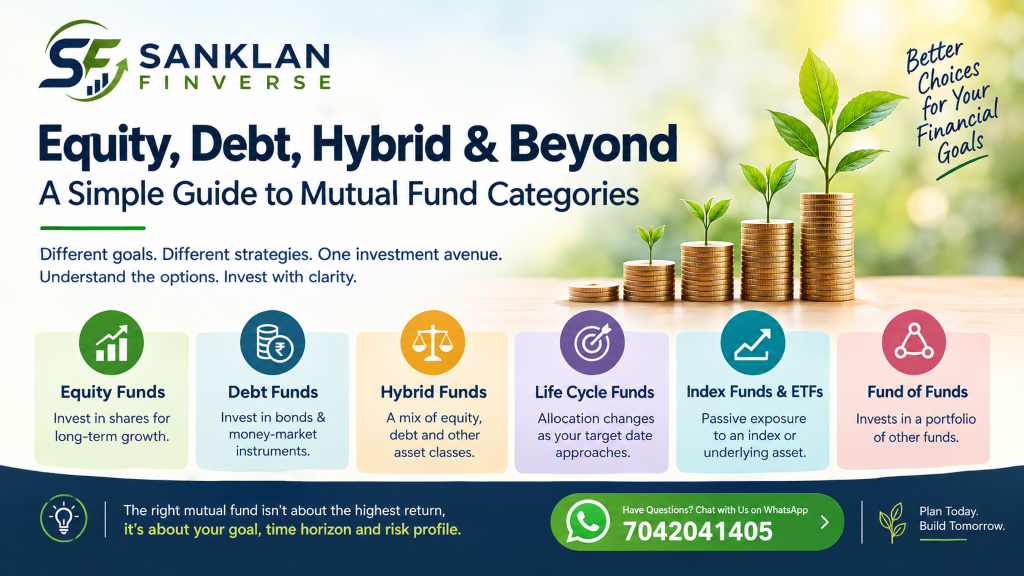
Under the current SEBI framework, mutual fund schemes are broadly classified into:
- Equity Schemes
- Debt Schemes
- Hybrid Schemes
- Life Cycle Funds
- Other Schemes, including Fund of Funds and passive schemes such as Index Funds and ETFs
It is worth noting that older articles may use a different classification. The mutual fund regulatory framework was revised in 2026, so investors should refer to the latest SEBI framework when understanding the current categorisation.
1. Equity Mutual Funds
Equity funds primarily invest in equity and equity-related instruments.
In simple words, your money is mainly invested in shares of companies.
The objective is generally long-term capital appreciation. However, equity markets can fluctuate significantly in the short term.
Some common equity fund categories include:
- Large Cap Funds
- Mid Cap Funds
- Small Cap Funds
- Large & Mid Cap Funds
- Multi Cap Funds
- Flexi Cap Funds
- Focused Funds
- Value-oriented Funds
- Sectoral Funds
- Thematic Funds
- Dividend Yield Funds
- ELSS
Two equity funds can have very different risk characteristics.
For example, a diversified equity fund and a sectoral fund are both equity funds, but a sectoral fund may have greater concentration in a particular sector.
What are the risks?
Equity funds can be affected by:
- Stock-market movements
- Company performance
- Economic conditions
- Interest rates
- Sector-specific developments
- Valuations
- Domestic and global events
Therefore, equity funds should not be considered guaranteed-return investments.
Equity simply describes the primary asset exposure of the fund.
2. Debt Mutual Funds
Debt funds primarily invest in debt and money-market instruments.
These may include:
- Government securities
- Treasury bills
- Corporate bonds
- Commercial paper
- Certificates of deposit
- Other permitted debt and money-market instruments
In simple terms, instead of primarily investing in company shares, a debt fund invests in instruments where the return is linked to debt investments.
Are Debt Funds Risk-Free?
No.
This is one of the most important things investors should understand.
Debt funds can face several types of risk.
Interest-Rate Risk
Changes in market interest rates can affect the market value of existing bonds and consequently the NAV of a debt fund.
Credit Risk
The issuer of a bond or other debt security may face financial difficulties or may not meet its obligations as expected.
Liquidity Risk
Some securities may be difficult to buy or sell at the desired price, particularly during stressed market conditions.
Therefore:
“Debt fund” does not automatically mean “safe” or “risk-free”.
The level of risk depends on factors such as the securities held, their credit quality, maturity and the investment strategy of the fund.
3. Hybrid Mutual Funds
Hybrid funds combine different asset classes within a single scheme.
The most familiar combination is:
Equity + Debt
However, under the current SEBI framework, hybrid schemes can invest in a combination of permitted asset classes, including equity, debt, InvITs and commodities-related instruments.
The basic idea is simple:
Instead of investing primarily in one asset class, the fund combines different asset classes according to its investment strategy.
Examples of Hybrid Funds
Some commonly encountered hybrid categories include:
| Category | Basic Idea |
|---|---|
| Conservative Hybrid | Predominantly debt with a smaller equity allocation |
| Aggressive Hybrid | Higher equity allocation along with debt exposure |
| Balanced Advantage / Dynamic Asset Allocation | Allocation between equity and debt can change according to the strategy |
| Multi Asset Allocation | Invests across multiple asset classes |
| Arbitrage | Seeks to benefit from price differences between related market positions |
| Equity Savings | Combines equity, arbitrage and debt exposure |
A hybrid fund can still lose money. The risk depends on its asset allocation, investment strategy and market conditions.
The word “balanced” should not be interpreted as “no risk”.
4. Life Cycle Funds
Life Cycle Funds are an important category under the revised 2026 framework.
A Life Cycle Fund is an open-ended fund with a target maturity date and a defined asset-allocation glide path.
The allocation can change as the target date approaches.
For example, a Life Cycle Fund with a long investment horizon may have relatively greater exposure to growth-oriented assets in the earlier years. As the target date gets closer, the portfolio can gradually move towards relatively more defensive assets.
The basic concept is:
More growth focus → Gradual change in allocation → Target date
However, a Life Cycle Fund does not guarantee the target amount or protect the investor from losses.
5. Index Funds
An Index Fund is a passive mutual fund designed to track a particular market index.
Instead of actively selecting stocks with the objective of outperforming the benchmark, an index fund generally attempts to replicate the performance of its chosen index, subject to expenses and tracking difference.
For example, an index fund may track a broad equity index.
The fund will generally hold securities in a manner designed to replicate the index.
The objective is therefore primarily to provide market/index exposure rather than rely on active stock selection.
6. Exchange Traded Funds (ETFs)
An ETF, or Exchange Traded Fund, is a fund whose units are traded on a stock exchange.
ETFs can provide exposure to different underlying assets or indices, depending on the ETF.
Examples include ETFs based on:
- Equity indices
- Gold
- Silver
- Debt indices
- Other permitted underlying assets
Because ETFs trade on an exchange, investors should also consider factors such as:
- Market price
- Liquidity
- Bid-ask spread
- Tracking difference
- Applicable transaction costs
The market price of an ETF can differ from its underlying NAV during trading.
7. Fund of Funds
A Fund of Funds, commonly called an FoF, is a mutual fund scheme that primarily invests in other funds rather than directly building its entire portfolio from individual securities.
The structure can be understood as:
Investor → Fund of Funds → Underlying Funds → Securities
An FoF can provide access to a particular investment strategy through underlying funds.
However, investors should also consider the expenses, structure and applicable taxation of the particular FoF.
Active vs Passive Mutual Funds
Another useful way to understand mutual funds is to look at how they are managed.
Active Funds
An active fund has a fund manager and investment team who actively select securities according to the scheme’s investment strategy.
The objective is to construct a portfolio that meets the scheme’s investment objective and, where applicable, outperform its benchmark.
Passive Funds
A passive fund generally attempts to replicate an index or predefined portfolio.
Examples include:
- Index Funds
- ETFs
The objective is generally to track the underlying index rather than continuously try to outperform it through active security selection.
One Category Does Not Mean One Risk Level
It is important not to assume that all funds within one category have the same risk.
Consider three equity funds:
Fund A: Diversified equity strategy
Fund B: Small-cap strategy
Fund C: Sectoral strategy
All three are equity funds, but their portfolios and risk characteristics can be very different.
The same applies to debt funds.
A short-duration debt fund, a long-duration debt fund and a fund with higher credit exposure can have very different risk characteristics.
Therefore:
“Category is the starting point, not the complete investment analysis.”
How Should You Think About Different Categories?
A simple way to understand them is:
Equity
“I want exposure primarily to businesses and the potential for long-term growth, and I understand that the value can fluctuate significantly.”
Debt
“I want exposure primarily to debt instruments, while understanding interest-rate, credit and liquidity risks.”
Hybrid
“I want a combination of different asset classes within one scheme.”
Life Cycle
“I want an investment strategy where asset allocation can change as the target date approaches.”
Index Fund / ETF
“I want passive exposure to a particular index or underlying asset.”
Fund of Funds
“I want exposure through a portfolio of other funds.”
These are simplified explanations and should not be considered individual investment recommendations.
Which Mutual Fund Category is Right for You?
There is no single mutual fund category that is best for everyone.
The appropriate category depends on several factors.
1. Your Financial Goal
Your investment objective could be:
- Retirement
- Child’s education
- House purchase
- Long-term wealth creation
- Short-term financial requirement
Different goals can have different investment horizons and risk requirements.
2. Your Investment Horizon
The amount of time available for investment is important.
A short-term requirement and a long-term wealth-creation goal may require very different investment approaches.
3. Your Risk Tolerance and Risk Capacity
You should understand how much volatility you can tolerate and whether you can financially withstand a temporary decline in your investment value.
4. Your Existing Portfolio
A mutual fund should not always be evaluated in isolation.
Your existing:
- Mutual funds
- Direct stocks
- Fixed deposits
- Bonds
- Gold
- Other investments
also form part of your overall portfolio.
Don’t Select a Fund Only Because It Recently Gave High Returns
One of the most common mistakes investors make is selecting an investment solely because it performed well recently.
A category that performed strongly in the past year may not necessarily perform similarly in the future.
Before investing, investors should consider:
- Investment objective
- Portfolio composition
- Risk level
- Investment horizon
- Fund strategy
- Costs
- Portfolio concentration
- Benchmark
- Historical performance
- Overall asset allocation
Past performance can provide useful information, but it does not guarantee future performance.
The Bottom Line
Mutual funds are not one single investment product.
They are a broad family of investment schemes with different objectives, portfolios and risk characteristics.
A simple way to remember the major categories is:
Equity → Shares and equity-related investments
Debt → Bonds and money-market instruments
Hybrid → Combination of different asset classes
Life Cycle → Asset allocation can change as the target date approaches
Index Fund / ETF → Passive exposure to an index or underlying asset
Fund of Funds → Investment through other funds
Understanding these categories can help investors make more informed decisions instead of selecting a mutual fund simply because it has delivered high returns recently.
The better question is not:
“Which mutual fund gives the highest return?”
A better starting question is:
“Which type of mutual fund is appropriate for my financial goal, investment horizon and risk profile?”
Once the appropriate category is understood, investors can then evaluate individual schemes in greater detail.
Disclaimer
This article is for educational and awareness purposes only. It should not be considered investment, financial, tax or legal advice. Mutual fund investments are subject to market risks. The risk factors, investment objective, asset allocation and other characteristics vary from scheme to scheme. Investors should read the Scheme Information Document (SID), Key Information Memorandum (KIM) and other relevant scheme documents carefully before investing.
Past performance does not guarantee future performance.
AI Assistance Disclosure
AI tools were used to assist with the initial drafting, structure and language of this educational article. The content has been reviewed against relevant SEBI and AMFI sources. Readers should refer to the latest regulatory information and scheme documents for current and scheme-specific details.
References
- SEBI – Master Circular for Mutual Funds, March 20, 2026
- SEBI – Categorization and Rationalization of Mutual Fund Schemes, February 26, 2026
- AMFI – Categorization of Mutual Fund Schemes
- AMFI – Types of Mutual Fund Schemes