

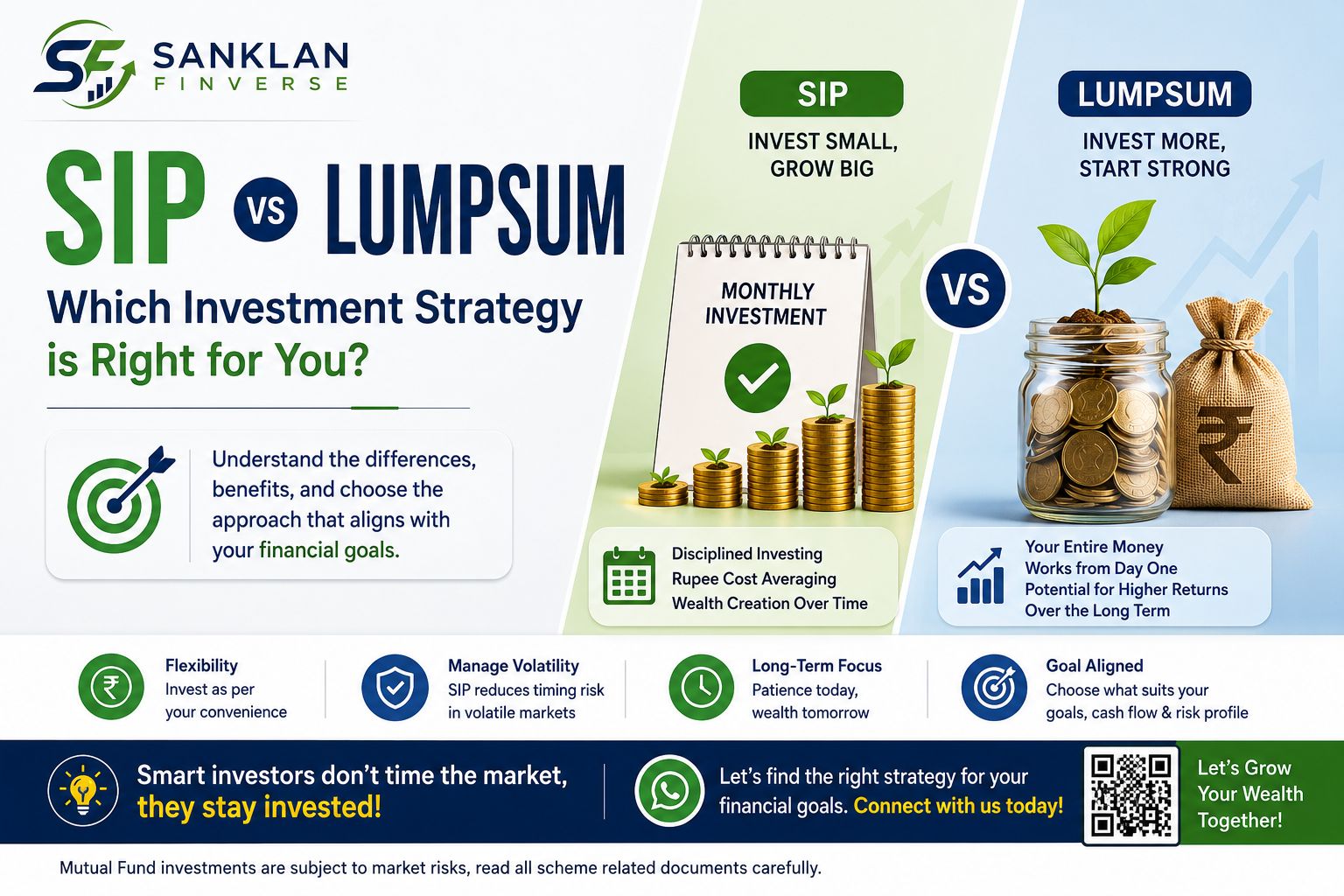
Investing in mutual funds is one of the most popular ways to build long-term wealth. However, one of the first questions many investors ask is:
Should I invest through a Systematic Investment Plan (SIP) or make a Lumpsum investment?
The answer depends on your financial situation, investment goals, and market conditions. Let’s understand both approaches and when each may be suitable.
What is a SIP?
A Systematic Investment Plan (SIP) allows you to invest a fixed amount at regular intervals, such as monthly or quarterly, into a mutual fund scheme.
For example, instead of investing ₹1,20,000 at once, you could invest ₹10,000 every month.
Benefits of SIP
- Disciplined investing: Helps build a regular investment habit.
- Affordable: You can start with relatively small amounts.
- Rupee Cost Averaging: You buy more units when prices are low and fewer units when prices are high, reducing the impact of market volatility.
- Power of Compounding: Regular investments over a long period can help your money grow through compounding.
SIP is suitable for
- Salaried individuals
- First-time investors
- Long-term wealth creation
- Retirement planning
- Children’s education planning
What is a Lumpsum Investment?
A Lumpsum investment means investing the entire amount in a mutual fund at one time.
For example, if you receive a bonus, inheritance, or proceeds from the sale of an asset, you may choose to invest the entire amount immediately.
Benefits of Lumpsum Investing
- Your entire investment starts working from day one.
- Can be beneficial if markets are reasonably valued and remain favorable over the long term.
- Suitable for investors who already have a large amount available for investment.
Lumpsum is suitable for
- Investors with surplus funds
- Long-term investors who can tolerate market fluctuations
- Investors with an emergency fund already in place
SIP vs Lumpsum: A Comparison
| Feature | SIP | Lumpsum |
|---|---|---|
| Investment Style | Regular installments | One-time investment |
| Investment Amount | Small periodic amounts | Entire amount at once |
| Market Timing Risk | Lower | Higher |
| Suitable For | Regular income earners | Investors with surplus funds |
| Volatility Impact | Reduced through Rupee Cost Averaging | Entire investment exposed immediately |
| Investment Discipline | High | Depends on the investor |
Which Option is Better?
There is no one-size-fits-all answer.
Choose SIP if:
- You earn a regular monthly income.
- You want to invest consistently.
- You prefer reducing the impact of market volatility.
- You are investing for long-term financial goals.
Consider Lumpsum if:
- You have a significant amount available to invest.
- Your investment horizon is long.
- You understand that markets may fluctuate in the short term.
In some situations, investors also use a combination approach—investing part of the amount immediately and the remaining amount gradually through a Systematic Transfer Plan (STP). This may help balance market timing risk while putting available capital to work over time.
Common Misconceptions
“SIP always gives better returns.”
Not necessarily. SIP helps reduce the impact of market volatility, but returns depend on market performance and the mutual fund scheme.
“Lumpsum is risky.”
Lumpsum investing is not inherently risky, but it carries greater market timing risk because the entire investment is made at one point in time.
“SIP guarantees profits.”
No investment in mutual funds guarantees returns. SIP is simply a method of investing and does not eliminate market risk.
Final Thoughts
Both SIP and Lumpsum investments are effective ways to invest in mutual funds. The right choice depends on your financial goals, cash flow, risk tolerance, and investment horizon.
Rather than trying to predict short-term market movements, focus on investing consistently, staying invested for the long term, and reviewing your portfolio periodically.
If you’re unsure which approach is suitable for your needs, consult a qualified Mutual Fund Distributor or financial advisor who can help you choose an investment strategy aligned with your financial objectives.
Disclaimer: Mutual fund investments are subject to market risks. Read all scheme-related documents carefully before investing. Past performance is not indicative of future results.
AI Assistance Disclosure : This article was prepared with the assistance of Artificial Intelligence (AI) and has been reviewed for accuracy and relevance by our Mutual Fund Distribution team. While every effort has been made to ensure the information is accurate as of the publication date, investors are encouraged to consult a qualified financial advisor or Mutual Fund Distributor for advice tailored to their individual financial circumstances.